How to Find an Apartment in Málaga, Spain: A Complete Guide for Foreigners
Finding an apartment in Málaga can be one of the most exciting, and frustrating, parts of moving to Spain.
You arrive with a picture in your head of your new life: morning coffee on the balcony, Spanish streets outside your window, the beach a short walk away and, finally, a place you can call home.
Then you start looking at rental listings.
And suddenly you are dealing with Spanish terminology, landlords asking for documents you weren't expecting, properties disappearing within hours, seasonal contracts, deposits, guarantors and rental prices that may be considerably higher than you imagined.
If that sounds familiar, you're not doing anything wrong.
The Málaga rental market can be competitive, particularly if you're looking for a genuine long-term home. Málaga has become increasingly popular with international residents, remote workers and people relocating to Spain, and that demand has put considerable pressure on the city's housing market.
As of June 2026, the average asking rent in Málaga city was €16.50 per square metre, according to Idealista. That was 5.6% higher than a year earlier. Prices also vary significantly between neighbourhoods, meaning where you choose to live can make a substantial difference to your monthly budget.
So, how do you actually find an apartment in Málaga?
Here's everything I wish more people knew before starting the search.
Before you start: understand what you're actually looking for
One of the biggest mistakes people make is opening a property website and immediately searching for apartments.
Before you do that, decide what “home” means for you.
Are you looking for:
A permanent home for several years?
A six-month rental while you settle in?
A furnished apartment?
An unfurnished property?
Somewhere close to the beach?
Somewhere close to work?
A central apartment where you can walk everywhere?
A larger, quieter apartment outside the city centre?
A temporary place while you search for something permanent?
These are very different searches.
If you're moving to Málaga from another country, you may also need to think about whether you can realistically sign a long-term rental immediately.
This is particularly important if you haven't started working in Spain yet.
A landlord may be much more comfortable renting to someone with a Spanish employment contract, Spanish payslips and a Spanish bank account than someone who has just arrived with savings and an overseas income.
That doesn't mean renting as a foreigner is impossible.
It simply means you need to understand how the market works before you start applying.
How much does it cost to rent an apartment in Málaga?
Let's start with the question almost everyone asks.
How much money do you actually need?
Málaga isn't the bargain that many people still imagine Spain to be.
In June 2026, Idealista recorded an average asking rent of €16.50/m² for Málaga city.
That doesn't mean every apartment costs the same.
A small apartment in a less expensive area can be considerably cheaper than a large, renovated apartment in a sought-after neighbourhood.
For example, Idealista's June 2026 figures showed significant differences across Málaga's districts:
Campanillas: €13.60/m²
Churriana: €14.10/m²
Cruz de Humilladero: €14.80/m²
Teatinos: €14.90/m²
Puerto de la Torre: €15.30/m²
Bailén-Miraflores: €15.40/m²
Carretera de Cádiz: €17.00/m²
Centro: €17.60/m²
Este: €17.70/m²
Martiricos-La Roca was considerably higher at €22.70/m².
These are asking-price averages, not guarantees of what you will pay for a particular apartment.
And there is another important point:
The cheapest apartment isn't necessarily the cheapest option overall.
An apartment that saves you €150 a month but requires a car, has expensive electricity bills and adds an hour to your daily commute may not actually be better value.
That's why I always recommend looking at the total cost of living, not just the rent.
If you want a more detailed breakdown of housing costs and realistic budgets, read my guide How Much Rent Really Costs in Spain alongside this article.
Which areas of Málaga should you consider?
This is where things become much more personal.
There isn't one “best” neighbourhood in Málaga.
There is only the neighbourhood that works best for your lifestyle, budget and priorities.
Centro
Living in the historic centre gives you incredible access to restaurants, shops, cultural attractions and nightlife.
You can walk almost everywhere.
But there are trade-offs.
The centre is busy, heavily visited by tourists and can be noisy, particularly around popular streets and nightlife areas. If you're looking for a peaceful long-term home, don't automatically assume that living in the centre is the dream.
It might be.
Or you might move out six months later.
Huelin and Carretera de Cádiz
These areas are worth considering if you want a more residential feel while still being relatively close to the city centre and the beach.
You have everyday shops, supermarkets, public transport and access to the coast.
They're also useful areas to investigate if you don't want to pay a premium simply for having the historic centre on your doorstep.
Pedregalejo and El Palo
If your dream is a more traditional coastal lifestyle, these areas are very appealing.
You get beach access, chiringuitos, restaurants and a more residential atmosphere.
The downside?
Demand can be high and prices aren't necessarily low simply because you're further east.
Teatinos
Teatinos is popular with students, professionals and families.
It's less postcard-perfect than the historic centre, but it can be a very practical place to live, particularly if you value newer buildings, transport connections and proximity to universities and hospitals.
Ciudad Jardín and other residential areas
If your priority is space and value rather than being five minutes from the beach, look further afield.
This is one of the most important lessons when apartment hunting in Málaga:
Don't search only where tourists stay.
You're not booking a holiday.
You're building a life.
For more context on the different parts of the city and what everyday life is actually like, have a look at my guide to Living in Málaga as an Expat. It goes into neighbourhoods, daily life, work, bureaucracy and the realities that don't always make it onto Instagram.
Where should you look for apartments in Málaga?
Once you know where you want to live, you can start searching.
One of the most commonly used platforms is Idealista, but don't rely on a single website.
Search across multiple platforms and also look at local estate agencies.
You should also pay attention to how recently a property was listed.
In a competitive market, a beautiful apartment at a realistic price may not remain available for long.
If something looks perfect and you wait three days before contacting the agent, you may already have missed it.
This is why apartment hunting in Málaga requires a slightly different mindset from casually browsing properties online.
You're not window shopping.
You're actively looking for a home in a competitive market.
The documents landlords may ask for
This is one of the biggest surprises for foreigners.
You may find an apartment you love, only to discover that the landlord wants an entire file of documentation.
Depending on your circumstances, this can include:
Passport or identity document
NIE
Employment contract
Recent payslips
Bank statements
Proof of income
Spanish bank account details
Previous rental references
Proof of savings
Tax documentation
Guarantor information
Not every landlord will ask for all of these.
And requirements can vary considerably between agencies and individual landlords.
But you should be prepared.
If you're moving to Spain without a Spanish job, for example, you may need to demonstrate your financial stability in another way.
This is one reason I recommend preparing your documentation before you start viewing apartments.
You don't want to find the perfect home and then spend a week trying to gather paperwork while somebody else gets approved.
Do you need a NIE to rent an apartment in Málaga?
This is a common question, and the answer isn't quite as simple as “yes” or “no”.
Your NIE is an important identification number for dealing with many administrative and financial matters in Spain.
However, the exact requirements for renting can vary depending on the landlord, agency and your circumstances.
If you are moving to Spain and haven't dealt with your NIE or padrón yet, it is worth understanding these processes early.
I have a complete NIE + Padrón Step-by-Step Toolkit designed specifically to take you through these processes without having to piece information together from dozens of different websites.
The important thing is not to assume that every part of your Spanish paperwork will happen in one neat sequence.
Spain rarely works quite that neatly.
Long-term rental vs seasonal rental in Málaga
This is really important.
When searching for an apartment, you'll probably come across terms such as:
larga temporada
alquiler temporal
alquiler de temporada
vacacional
They don't all mean the same thing.
If you're moving to Málaga because you want to live here permanently, you need to pay close attention to what type of rental you're actually looking at.
Some properties are specifically marketed for temporary stays and may only be available for a few months.
This can be particularly common in popular coastal areas.
A listing might look perfect until you realise the owner wants the property back at the end of the summer.
That's not necessarily a bad thing — it just isn't the same as finding your long-term home.
Always ask:
“¿Es alquiler de larga temporada?”
and
“¿Cuál es la duración del contrato?”
before getting too attached to the property.
What should you expect to pay upfront?
Finding the apartment is only half the financial equation.
You also need to budget for the money required to move in.
For a standard residential rental, Spanish law requires a cash deposit, or fianza, equivalent to one month's rent. Additional guarantees can also be agreed, subject to legal limits for qualifying residential contracts.
So if your rent is €1,200 per month, you shouldn't assume that €1,200 is all you'll need on moving day.
You may need money available for:
First month's rent
Deposit
Additional legally permitted guarantee, where applicable
Moving costs
Utility setup or transfers
Furniture or household items
Insurance, depending on the arrangement
And don't forget the basics.
You might have an apartment with a beautiful terrace and absolutely no kitchen equipment beyond the basics.
Or a washing machine that looks like it has survived three generations.
Or an air-conditioning system that works beautifully in the viewing but becomes mysteriously complicated once you move in.
Ask questions before signing.
What about agency fees?
This is another area where renters should understand their rights.
For residential rentals covered by Spain's rental law, real-estate management and contract-formalisation costs are charged to the landlord, rather than the tenant.
That doesn't mean you should assume every fee mentioned by an agency is automatically legitimate or automatically prohibited.
The nature of the rental matters, particularly where temporary or other types of contracts are involved.
This is exactly why you should read the contract carefully rather than simply paying whatever amount you're told.
If you're unsure about the terminology, my Complete Guide to Rental Contracts in Spain is designed to help you understand what you're actually signing before you hand over your money.
Never sign a rental contract you don't understand
This sounds obvious.
But when you've spent three weeks searching for an apartment and someone finally says:
“You can move in next week.”
it's incredibly tempting to sign anything put in front of you.
Don't.
Read the contract.
Check:
The monthly rent
Contract duration
Renewal conditions
Deposit
Additional guarantees
Included utilities
Community fees
Maintenance responsibilities
Notice requirements
Inventory
Furnishings
Rules relating to pets
Any restrictions on guests or subletting
What happens when something breaks
You don't need to become a Spanish property lawyer.
But you do need to understand the agreement you're entering into.
If the contract is in Spanish and you're not comfortable reading legal or rental terminology, get help before signing rather than after something goes wrong.
What to look for during the apartment viewing
Photos are not enough.
Actually viewing the apartment is important.
And when you do, don't just look at whether the kitchen looks Instagram-worthy.
Look at the boring things.
They're usually the things that matter most once you live there.
Check the natural light
An apartment can look bright in professional photographs and feel completely different in real life.
Visit during the day and consider which direction the windows face.
Check the noise
Open the windows.
Listen.
Is there traffic?
A bar downstairs?
A school?
A busy road?
A tourist apartment next door?
Your dream balcony may feel very different at 2 a.m.
Check the air conditioning and heating
Málaga gets hot.
Very hot.
And some apartments are much better equipped for the climate than others.
Ask how the apartment is heated and cooled and whether the systems actually work.
Check the windows
Good windows and insulation can make a huge difference to comfort and energy costs.
Older apartments can have beautiful character but may also have single glazing and limited insulation.
Check water pressure
Turn on the taps.
Check the shower.
It sounds ridiculous until you're standing under a shower that produces approximately three drops of water per minute.
Check the storage
This is one people constantly overlook.
Where will your suitcases go?
Your winter clothes?
Cleaning products?
Shoes?
Kitchen equipment?
An apartment can feel spacious when it's empty and tiny once you actually live in it.
Ask these questions before you commit
Don't be afraid to ask questions.
You are not being difficult.
You're trying to understand the home you're about to rent.
Some useful questions include:
¿Cuánto tiempo lleva el piso en alquiler?
How long has the apartment been available?
¿Los gastos están incluidos?
Are utilities or other costs included?
¿Cuánto es la fianza?
How much is the deposit?
¿Es alquiler de larga temporada?
Is this a long-term rental?
¿Qué duración tiene el contrato?
How long is the contract?
¿Se puede empadronar aquí?
Can I register on the padrón at this address?
¿Quién paga la comunidad?
Who pays the community fees?
¿Quién se encarga de las reparaciones?
Who is responsible for repairs?
Learning a few basic Spanish phrases can make the entire process easier.
And even if your Spanish isn't perfect, trying goes a long way.
One of the biggest mistakes: searching for the perfect apartment
This might sound strange coming from someone writing an apartment-hunting guide.
But hear me out.
When you're moving to Spain, it's very easy to create a fantasy apartment in your head.
Beachfront.
Terrace.
Two bedrooms.
Air conditioning.
Beautiful kitchen.
Modern bathroom.
Walkable to the centre.
Quiet.
Close to supermarkets.
And €900 a month.
You might find it.
But you probably shouldn't build your entire relocation plan around it.
The Málaga property market requires compromise.
Maybe you choose a smaller apartment.
Maybe you live 20 minutes further from the centre.
Maybe you prioritise a good transport connection over a sea view.
Maybe you rent somewhere temporary before finding your long-term home.
The goal isn't to find an apartment that looks perfect on Instagram.
The goal is to find somewhere that works for your actual life.
Should you rent before moving to Málaga?
If you're relocating from another country, this is a big decision.
There are two broad approaches.
Option one: secure a long-term apartment before arriving
This sounds ideal.
You land at Málaga Airport, pick up your keys and go straight home.
The problem is that it's difficult to properly assess an apartment, neighbourhood and landlord from another country.
You also risk sending money for a property you haven't physically seen.
Option two: arrange temporary accommodation first
This gives you time to arrive, explore different neighbourhoods and attend viewings in person.
For many people, this is the less stressful option.
You might spend your first few weeks or months in temporary accommodation while you search for something permanent.
It costs more in the short term, but it can prevent you from committing to the wrong neighbourhood or apartment.
For a major international move, paying a little more for flexibility can sometimes save you a lot more later.
What if you don't have a Spanish salary yet?
This is one of the biggest challenges for newly arrived foreigners.
Imagine this:
You have €30,000 in savings.
You have a remote job earning €3,000 a month.
You can comfortably afford the rent.
But the landlord wants Spanish payslips.
Suddenly, your financial situation doesn't look quite as straightforward from their perspective.
This is where having a strong application package can help.
Prepare everything you can in advance:
Passport
NIE, if available
Employment contract
Proof of income
Recent bank statements
Savings evidence
References
Previous rental information
Proof of remote employment, where applicable
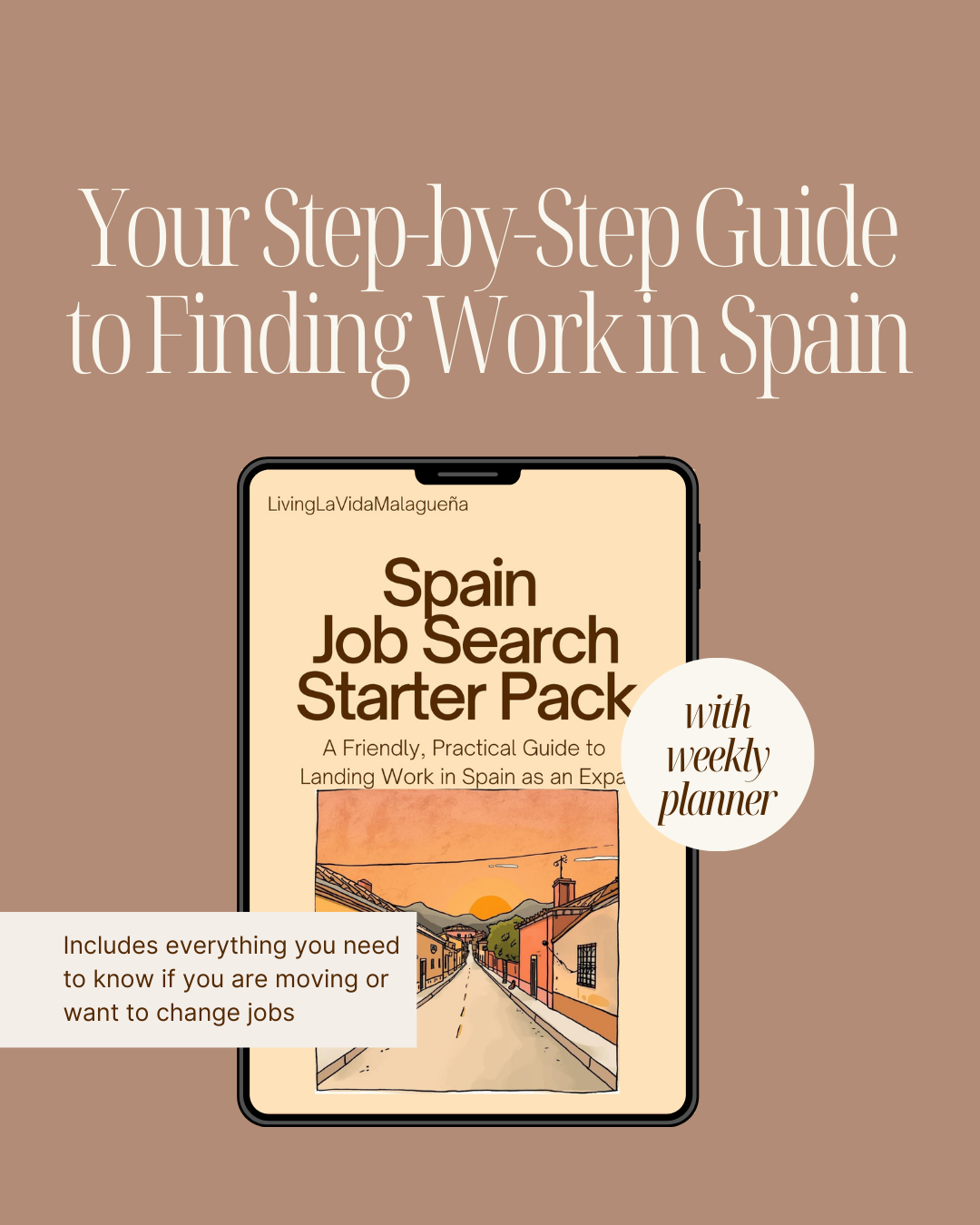
If you're still trying to find work in Spain, the situation is slightly different. In that case, it's worth reading my resources around finding work in Spain before committing to a rental budget.
Your housing budget needs to make sense alongside your income.
Don't forget the commute
This is one of the easiest mistakes to make when moving to Málaga.
You find a beautiful apartment outside the city.
It's €300 cheaper.
It has two bedrooms instead of one.
The terrace is enormous.
You are convinced you've found a bargain.
Then you discover your daily commute takes an hour and a half.
Málaga's wider metropolitan area offers plenty of alternatives, and nearby municipalities can sometimes offer lower rental prices than the city. For example, June 2026 asking rents were around €12.10/m² in Torre del Mar and €10.60/m² in Vélez-Málaga, compared with €16.50/m² in Málaga city.
But cheaper rent can come with other costs.
Transport.
Time.
Fuel.
Parking.
Potentially a car.
So calculate the whole lifestyle before deciding.
What I would do if I were apartment hunting in Málaga today
If I were starting from scratch, I would do it in this order:
First, decide on my realistic monthly budget.
Not the amount I want to spend.
The amount I can comfortably afford after considering utilities, transport, food and everything else.
Second, choose three or four neighbourhoods.
Not one.
Give yourself alternatives.
Third, prepare my documentation.
Have everything ready before contacting agencies.
Fourth, monitor the rental platforms every day.
Set alerts where possible.
Fifth, contact properties quickly.
Don't wait several days if something genuinely works for you.
Sixth, view apartments in person whenever possible.
Photos are not enough.
Seventh, compare the total cost.
Rent + utilities + transport + deposits + other costs.
Eighth, read the contract before signing.
Not after.
Before.
And finally:
Don't panic if your first apartment isn't your forever apartment.
Your first home in Málaga is allowed to simply be your first home.
A final word about renting in Málaga as a foreigner
Finding an apartment in Málaga can feel overwhelming because you're not just learning how to rent a property.
You're learning how to rent a property in another country, often in another language, while simultaneously figuring out your new life.
That's a lot.
And if the process feels more complicated than you expected, you're definitely not alone.
The good news is that once you understand the terminology, the paperwork, the different types of rental contracts and what landlords are looking for, the process becomes much easier to navigate.
You don't need to know everything.
You just need to know what to look for, what questions to ask and when to slow down before signing something.
Málaga is still an incredible place to build a life. But finding that life starts with the practical stuff — including finding somewhere you actually want to come home to.
And that apartment may not be the one with the perfect sea view.
It might be the slightly smaller one in the neighbourhood where you eventually make friends, learn the local bakery's opening hours and start recognising your neighbours.
Because that's the difference between renting an apartment in Málaga and actually living in Málaga.
Want to make the process easier?
If you're moving to Málaga and want practical, straightforward guidance rather than trying to piece everything together from dozens of websites, I've created resources to help.
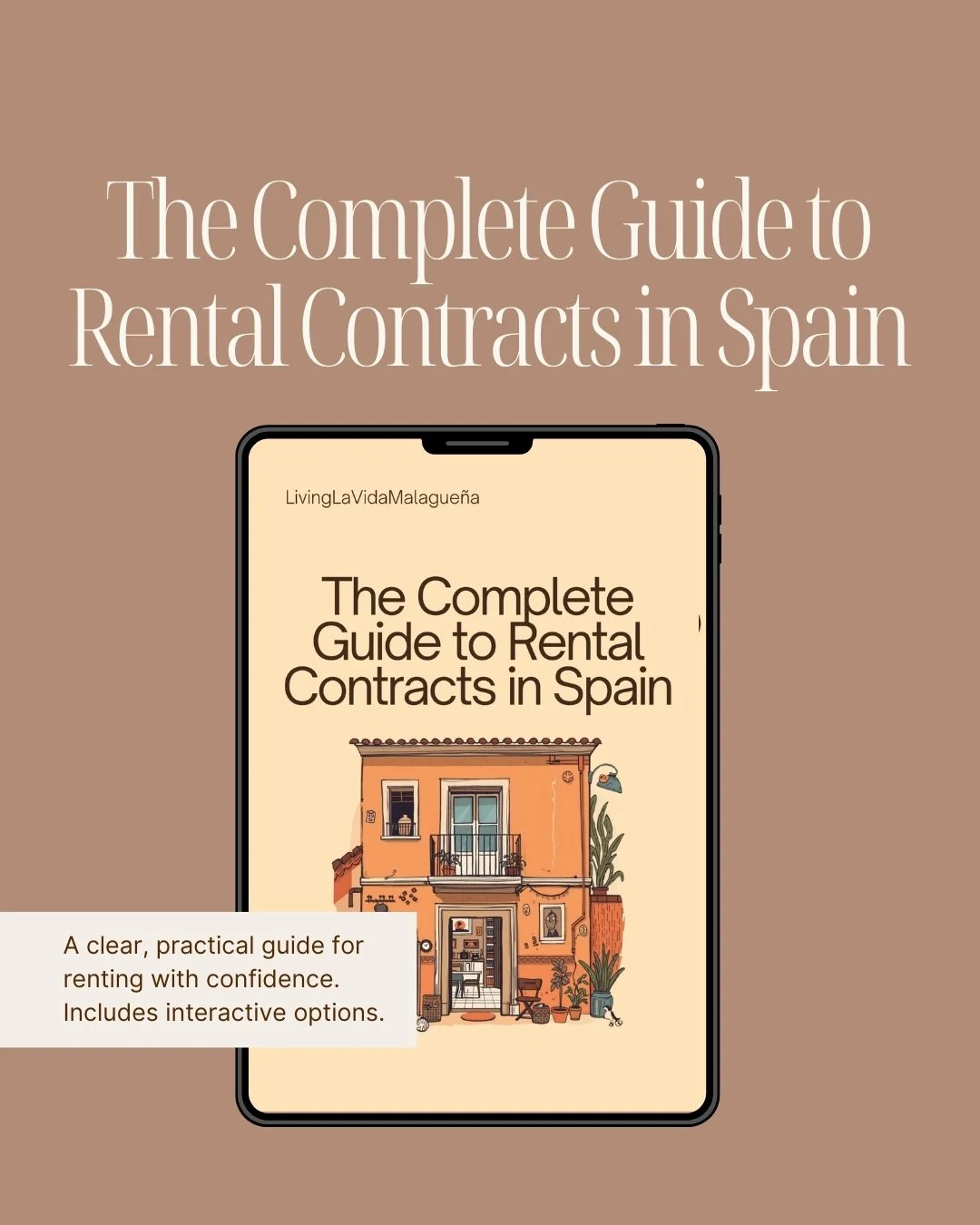
The Complete Guide to Rental Contracts in Spain is designed to help you understand the contract you're signing, what to look out for and the terminology that can otherwise feel incredibly confusing.
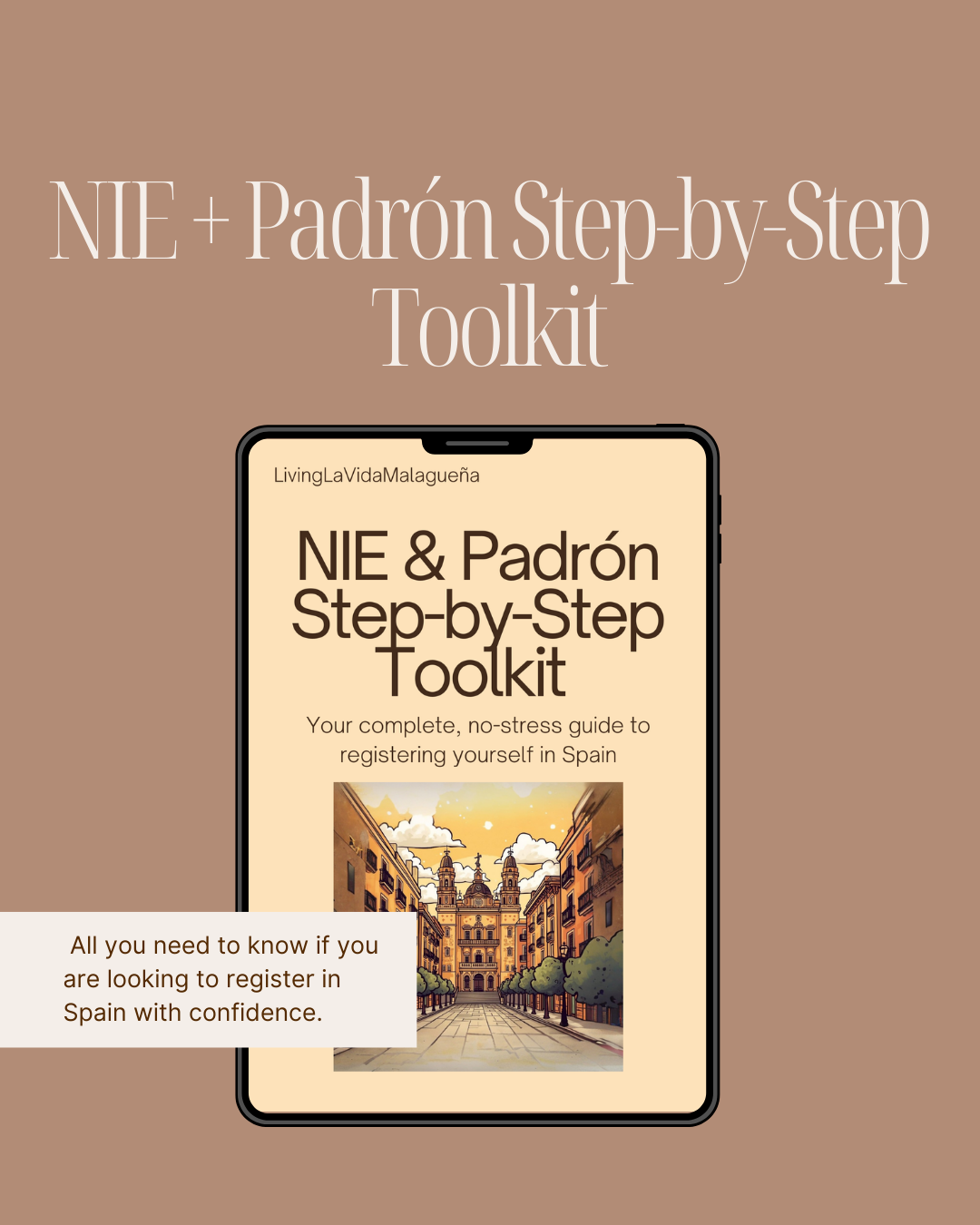
If you're still working through your Spanish paperwork, the NIE + Padrón Step-by-Step Toolkit takes you through those processes step by step.
And if you're already in Málaga and want a broader guide to actually settling into the city, the Málaga Insider Survival Guide covers neighbourhoods, renting, daily life, culture, routines and the realities of living here as a foreigner.
You can explore all Living La Vida Malagueña digital guides here.
And if your situation is more complicated — perhaps you're unsure which area to choose, what you can realistically afford, whether your documentation is enough, or how to approach your move — you can also book a private consultation and we can look at your specific situation together.
Moving to Spain is a huge decision.
Finding a home shouldn't have to feel impossible.
Welcome to Málaga.


Plan Your Move to Spain with Confidence
Moving to Spain is an exciting new chapter, but it also comes with countless tasks, deadlines, and important decisions. From researching visa options and preparing your paperwork to organising your finances, finding accommodation, and planning your arrival, it's easy to feel overwhelmed before you've even packed your suitcase.
The Moving to Spain Checklist & Relocation Planner has been created to help you stay organised throughout the entire relocation process. Instead of managing multiple lists, scattered notes, and endless browser tabs, you'll have one structured planner that guides you through every stage of your move.
Whether you're relocating in a few weeks or simply starting to plan your future in Spain, this practical digital guide provides a clear roadmap to help you stay on track and avoid missing important steps along the way.
Designed by Living La Vida Malagueña, this planner is based on real relocation experience and is intended to simplify the planning process, giving you more confidence as you prepare for your new life in Spain.
What You'll Receive
Your digital planner includes practical checklists and timelines covering every stage of your relocation, including:
Comprehensive Moving to Spain master checklist
Step-by-step relocation timeline
Visa and residency preparation checklist
Financial planning checklist
Accommodation and housing planner
Pre-departure moving checklist
Arrival and settling-in checklist
Printable PDF that can also be completed digitally
Who This Planner Is For
This planner is ideal for:
Anyone planning to move to Spain
First-time expats
Retirees relocating abroad
Digital nomads
Remote workers
Families moving to Spain
Anyone looking for a clear, organised relocation plan
Whether you're moving independently or with your family, this planner helps you approach the process with greater organisation and less stress.
Why You'll Love It
Relocating abroad involves dozens of moving parts, and it's surprisingly easy to overlook important tasks.
This planner has been designed to keep everything together in one place, helping you:
Stay organised throughout your move
Reduce last-minute stress
Keep track of important deadlines
Plan your relocation step by step
Feel more confident during every stage of the process
Simple, practical, and easy to use, you can either print the planner or complete it digitally—whatever works best for your planning style.
Instant Digital Download
This is a digital product.
No physical item will be shipped.
Once your purchase is complete, you'll receive immediate access to download your planner so you can start organising your move straight away.
Please Note
This planner has been created for educational and organisational purposes only.
It does not constitute legal, immigration, tax, or financial advice. Visa regulations and residency requirements can change, so you should always confirm the latest information with the relevant Spanish authorities before making important decisions.
Looking for Personalised Help?
If you'd like tailored advice based on your own relocation plans, you can also book a 45-minute private consultationthrough Living La Vida Malagueña.
Together we'll discuss your situation, answer your questions, and create a personalised action plan to help make your move to Spain smoother and more straightforward.